1
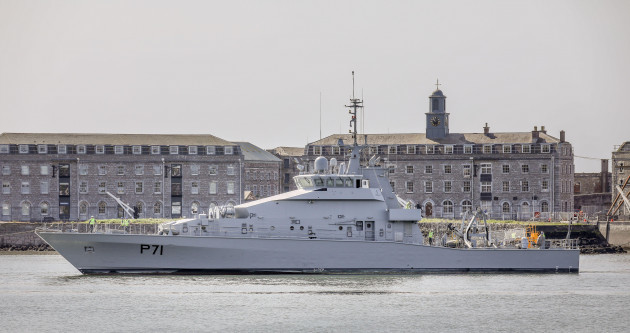
TWO NEW SHIPS, equipped with a suite of electronic warfare and surveillance equipment, will be deployed on shorter missions on the south and east coasts, the navy has announced.
At an event in Haulbowline Island Naval Base in Cork Harbour military top brass along with Tánaiste Micheál Martin and General Secretary of the Department of Defence toured the vessels.
The new Inshore Patrol Vessels (IPV) have arrived in at the instillation near Cobh after a 35 day, 10,000 nautical mile voyage from Auckland, New Zealand.
Commodore Michael Malone, Flag Officer Commanding of the Naval Service, said that the new ships will introduce, for the first time, new world leading technology for electronic warfare and surveillance.
“This IPV procurement and timely delivery is a vital part of the Naval Service’s HR regeneration efforts and will assist the Naval Service in returning to its mandated number of hulls.
“The IPV’s will introduce certain new Electronic Warfare and intelligence gathering capabilities and enhance the patrol profile of the Naval Service on the East and South East Coast,” he said.
Sources have said that it is understood that the operations will be focused on specific taskings and with the sensor suite on board will be engaged in drugs interdiction as well as state security operations. They will also be available for maritime rescue operations and boardings.
Tánaiste and Minister for Defence Micheál Martin admitted that there are significant challenges in the Naval Service but said that the new ships were a step forward in capability.
“The Government has acknowledged that there are ongoing challenges in the Naval Service and these are being addressed as part of a planned approach to regeneration of the Naval Service. This has seen the withdrawal of three ships from service – LÉ Orla, LÉ Ciara and LÉ Eithne and their replacement on a phased basis,” he said.
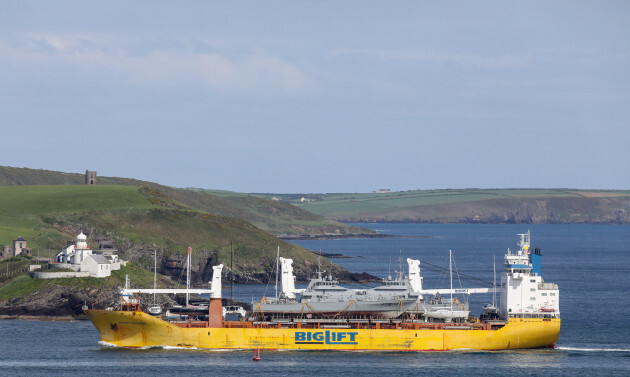
Orla and Ciara
The cost for the ships is €26 million and they will replace for LÉ Orla and LÉ Ciara.
“These Inshore Patrol Vessels have a lesser crewing requirement than the ships they replace, and will provide the Naval Service with an enhanced capacity to operate and undertake patrols in the Irish Sea on the East and South East Coast. This will allow the remaining fleet to focus on operations elsewhere,” he said.
Martin paid tribute to the Irish Naval Service members involved in the project and their colleagues in New Zealand.
“This is not the end of these ships voyage, they will undergo further work in the Naval Base in Cork. Then following familiarisation, crew training and preparation for operational readiness, they will both be named and commissioned into the Irish Naval Service before commencing their operational service early next year,” he said.
Lieutenant General Seán Clancy, Defence Forces Chief of Staff, said that changes in maritime security in the Irish Sea “highlighted a requirement for a specialist inshore capability in order to protect Irish interests”.
He added that he believes the new IPVs will allow the Naval Service to continue to modernise and tackle the dynamic and ever changing maritime environment that we operate in 365 days a year.”
The Defence Forces has carried out a capability review and have identified that the IPVs are suitable for Irish operations in the Irish Sea on the east and south-east coast.
From a human resources perspective the nature of patrols conducted by the IPVs will be shorter in duration compared to the three week long traditional patrols conducted by the Naval Service. It is believed that the potential for more day long patrols will provide for a more family friendly working environment for the crew and support personnel.
The two Lake–Class IPVs are the former HMNZS Rotoiti and Pukaki and the project to take them over began in March of 2022.
The ships are highly manoeuvrable and capable of speeds up to 25 knots (46 kilometres per hour) – they will have 20 permanent crew with a capacity to take up to 16 others.
Transportation from New Zealand to Ireland was on board Sevenstar-EMT’s Happy Dynamic, a large 157m in length and 26m beam, almost 15,000-ton cargo ship.
Sources have said that it is likely that at least one of the vessels will be based in Dun Laoghaire, Co Dublin.
Chief of European Navies
Meanwhile, as the two new ships were being welcomed, the annual Chiefs of European Navies (CHEN) meeting is taking place in Cork.
The organisation’s website defines itself as: “It is an informal, independent and non-political forum whose membership includes the Chief of Navy of each European maritime nation that is either a member of NATO or the EU and has naval armed forces”.
Commodore Malone said: “CHENS continues to be a valued platform to ensure naval relevance in a rapidly changing future as we continue to find innovative solutions to our shared challenge of leading Navies that are always moving forward, modernizing and diversifying”.
The 27-member body is open to any European nation which has a navy and is either a member of the EU or Nato. The Irish Navy has been a member of CHEN for the last 15 years.
The meetings will be attended by EU naval top brass and by senior US Navy commanders as observers. There will also be representatives of Nato’s Allied Maritime Command and senior officials from the EU’s military staff.
from JC’s Naval, Maritime and Military News https://ift.tt/zxYbt1u
via IFTTT
Discover more from JC's Royal New Zealand Navy, World Navies, Military News, Lighthouses and other Marine News-
Subscribe to get the latest posts sent to your email.