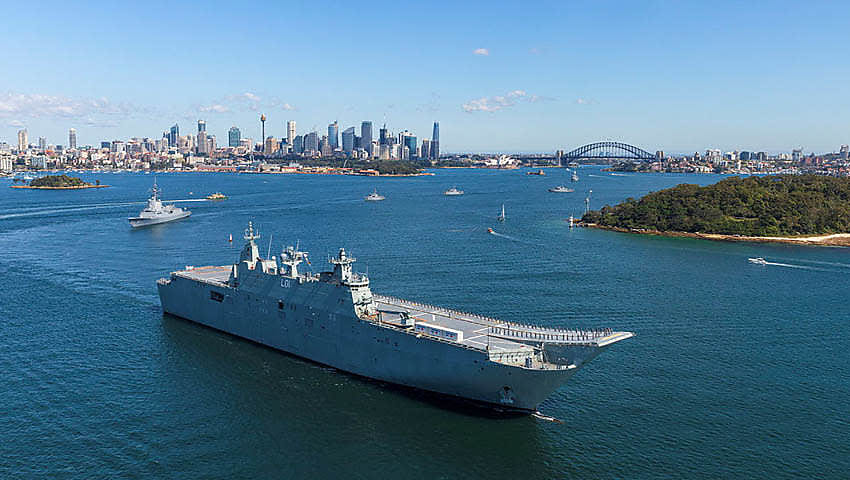
With the Australian Navy’s surface fleet review front and centre for many in the Defence policy community, what can we expect, and better yet, what should we expect from the largest, single review into the structure of Australia’s future naval surface fleet?
As an island nation, Australia’s sovereignty, security, and economic prosperity is intrinsically linked to the stability of our maritime surrounds and the nation’s uncontested and unmolested access to the global maritime commons.
This reality is critically important in the light of mounting regional and global naval build ups, serving as the driving force behind the nation’s transformative pursuit of the trilateral AUKUS agreement delivering the nation’s nuclear-powered submarine fleet as the centrepiece of Australia’s strategic deterrence capabilities.
Recognising the centrality of maritime security and stability, the government’s Defence Strategic Review (DSR) reinforced the renewed importance of the nation’s maritime security, with the Royal Australian Navy requiring an immense and comprehensive restructuring to optimise the fleet for the future tactical and strategic challenges we face throughout the Indo-Pacific.
Highlighting this, the DSR explains, “Australia’s Navy must be optimised for operating Australia’s immediate region and for the security of our sea lines of communication and maritime trade.”
To deliver this, the DSR has emphasised a three-pronged approach, renewing and reinforcing the nation’s commitment to the AUKUS trilateral agreement and the nation’s pathway to delivering the SSN-AUKUS, nuclear-powered submarines and what is described as the fundamental realignment and restructuring of the surface combatant fleet, best explained: “An enhanced lethality surface combatant fleet, that complements a conventionally armed, nuclear-powered submarine fleet, is now essential given our changed strategic circumstances.”
This major step change in the thinking of Navy’s mission profile, responsibilities, and implications for force structure has been further influenced by the government’s plans to field two distinct tiers that are capable of “enhancing Navy’s capability in long-range strike (maritime and land), air defence, and anti-submarine warfare requires the acquisition of a contemporary optimal mix of Tier 1 and Tier 2 surface combatants, consistent with a strategy of a larger number of small surface vessels”.
However, in order to deliver this desired outcome, the government has initiated yet another “short, sharp” review into the size, composition, and nature of Australia’s future surface fleet force structure and the way in which it complements the nation’s future nuclear-powered submarine fleet.
https://ift.tt/fkaCquc
from Blogger https://ift.tt/cDui31n
via IFTTT
Discover more from JC's Royal New Zealand Navy, World Navies, Military News, Lighthouses and other Marine News-
Subscribe to get the latest posts sent to your email.